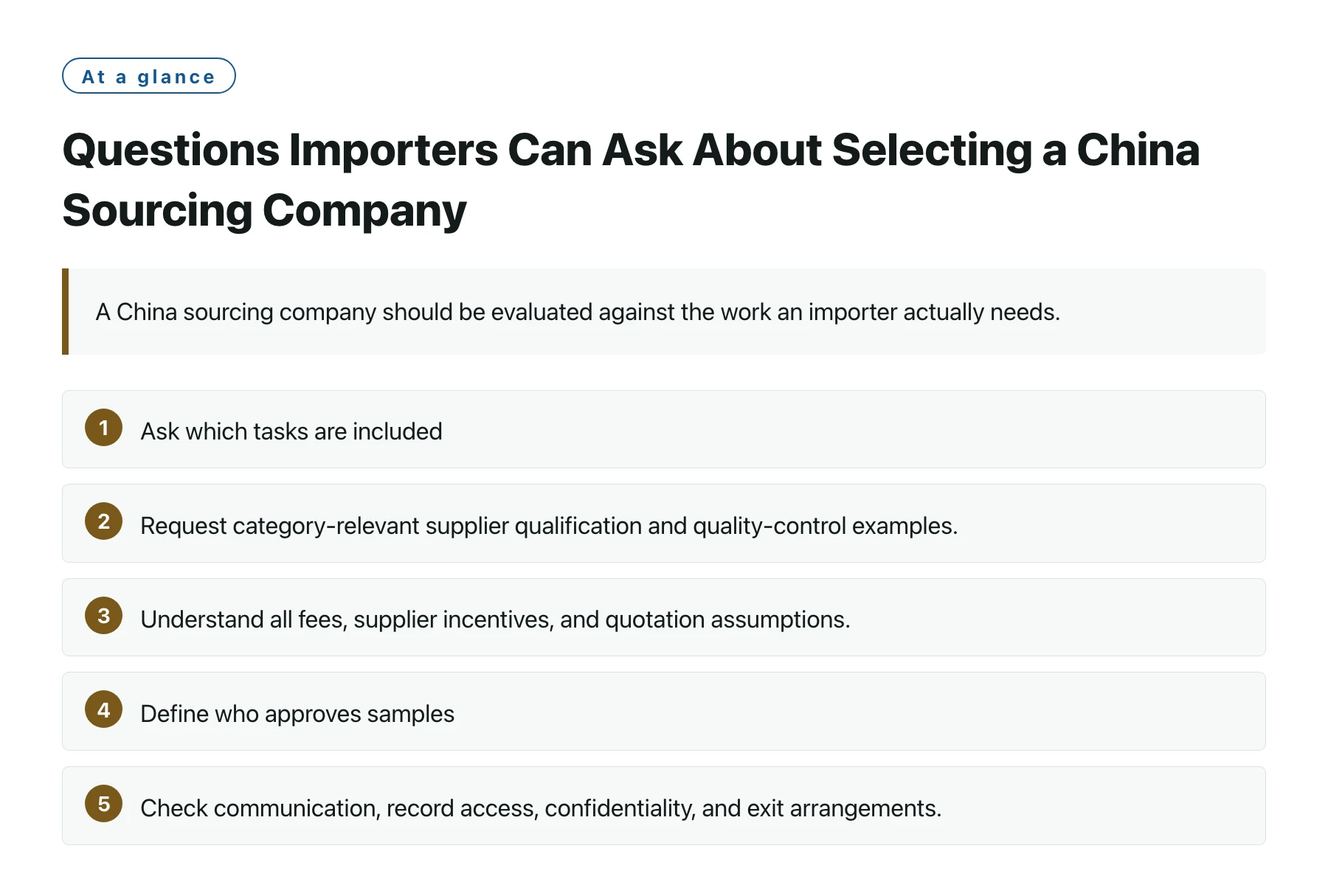
A China sourcing company should be evaluated against the work an importer actually needs. Ask how it finds and qualifies suppliers, compares quotations, manages samples and changes, coordinates inspections, explains fees, and escalates problems. Request evidence that fits the product category and destination market. Then write down responsibilities and approval rights before an order starts. A polished introduction is useful, but a clear operating process is what lets a buyer judge whether the provider can support a specific project.
Key takeaways
- Ask which tasks are included, excluded, and performed by third parties.
- Request category-relevant supplier qualification and quality-control examples.
- Understand all fees, supplier incentives, and quotation assumptions.
- Define who approves samples, deviations, inspections, and shipment release.
- Check communication, record access, confidentiality, and exit arrangements.
Use the same core questions with each candidate so proposals can be compared on equal terms.
1. What problem will the sourcing company own?
Describe the products, quantity, destination, schedule, and risks that require support. Ask the provider to map its work from supplier search through quotation, sampling, production follow-up, inspection, and shipment coordination. Request named deliverables for each stage, such as a supplier shortlist, comparison sheet, sample register, or corrective-action log. A broad statement that the company can “handle everything” does not define who performs or approves each task.
Ask which responsibilities remain with the importer. Buyers generally need to retain clear control of specifications, market obligations, commercial approval, and final acceptance unless a contract and applicable law assign a particular role differently. CIPS supplier-evaluation guidance describes setting criteria and evaluating supplier capabilities and resources; buyers can use that logic to define criteria for the sourcing provider itself. [1]
2. How are suppliers identified and checked?
Ask how candidates are found and how business identity, factory location, product capability, capacity, and relevant experience are checked. Ask what evidence is collected, how recently it was updated, and what happens when an important item cannot be verified. For higher-risk products, ask whether site visits, technical specialists, audits, or independent testing are available and when they are recommended.
Find out whether the provider has commercial relationships with recommended suppliers, receives referral fees, or earns commissions on orders. Ask how it discloses and manages possible conflicts and whether it can present alternatives. A relationship is not by itself proof of poor advice, but the buyer should understand how recommendations are made and which party benefits from a selection.
3. What category expertise can be demonstrated?
Ask for examples tied to your product family, manufacturing process, destination market, and order scale. Useful evidence may include a redacted quotation comparison, sample review, production risk assessment, inspection report, or documented change. Ask what technical questions the team can handle internally and which need a qualified engineer, laboratory, compliance adviser, or other specialist.
Check whether the provider understands the differences among your product variants rather than only naming a broad industry. Ask how it prevents details such as material grade, finish, tolerances, packaging, or included accessories from disappearing in translation between a buyer brief and supplier quotation. Request an explanation of one real risk it identified and how the buyer was asked to decide.
4. How will quotes and fees be made comparable?
Provide a sample request and ask the candidate to explain how it will compare supplier offers. Check whether the comparison includes product specification, tooling, packaging, testing, order quantity, payment terms, currency, validity period, freight assumptions, and exclusions. Ask for a landed-cost view only when its assumptions and responsibilities are clear. A low unit quote can be misleading if critical cost items are omitted.
Request a complete fee schedule: fixed or percentage-based service fees, commissions, supplier-paid charges, inspection costs, translation, samples, freight handling, and any minimums. Ask how exchange rates and scope changes affect charges and which costs require prior approval. Compare providers using the same assumptions. Do not rely on an informal statement that a service is “free” without understanding how the provider is compensated.
5. How are samples, quality, and changes controlled?
Ask who writes or confirms inspection criteria, who selects samples, and how results are connected to the approved specification. Find out how the provider records sample revisions, production deviations, factory substitutions, material changes, and rework. Request a sample report that identifies the product, lot, method, finding, evidence, and disposition. Determine whether inspections are performed by the provider, an affiliate, or an independent party.
Ask what happens when goods fail a check: who holds production or shipment, who authorizes rework or replacement, whether reinspection is included, and how costs are handled. No inspection report can replace product-specific testing or market compliance review when those are required. Make technical authority and final release rights explicit in the agreement.
6. What records and communication will the buyer receive?
Ask what project information is shared, how often status is updated, and where the authoritative decision record lives. Request a sample report or portal view showing open actions, owners, due dates, supplier responses, and evidence links. Clarify file access, data ownership, confidentiality, retention, and whether the importer can export all records if the relationship ends.
Agree response expectations for routine questions and urgent production, quality, or logistics issues. Ask for named primary and backup contacts, local working hours, escalation thresholds, and a process for documenting phone or chat decisions. A buyer should be able to identify which specification or sample version the factory is following without reconstructing the answer from private messages.
7. How will performance and accountability be reviewed?
Set a small number of measurable outcomes that matter to the project: completeness of supplier evidence, quote comparability, milestone visibility, sample turnaround, timely escalation, or closure of corrective actions. Define how each is measured and reviewed. Avoid setting targets that reward fast responses while ignoring accuracy, risk disclosure, or quality follow-through.
Ask about contract term, liability, insurance, confidentiality, subcontracting, termination, and transition support. Confirm that the agreement identifies governing documents and what happens to supplier contacts, tooling, samples, and project data on exit. Use a limited pilot when appropriate, then review evidence before adding more categories or larger orders.
8. Compare proposals with one scorecard
Create a scorecard with category fit, supplier checks, quotation quality, quality process, communication, transparency, compliance coordination, and commercial terms. Give higher weight to risks that matter for your product and market. Record a short reason and supporting evidence beside each score. If a critical capability is absent, mark it as a gap instead of allowing unrelated strengths to compensate automatically.
Before a first meeting, review the provider overview and View details about its sourcing support, then use these questions to test the actual workflow. Compare candidates against the same order brief, ask for clarifications in writing, and record unresolved assumptions. The strongest proposal is the one whose responsibilities, evidence, and limitations are clear for the importer’s specific work.
Sources
Frequently asked questions
What is the most important question to ask a sourcing company?
Ask for a step-by-step account of the work it will perform, the evidence it will provide, and the decisions that remain with you. Then test that description against a product-specific example.
Should a sourcing company select suppliers without buyer approval?
Agree the shortlist and approval gates in advance. The provider may recommend candidates, but the buyer should know the criteria, evidence, relationships, and final authorization process.
How can an importer compare service fees?
Compare total costs using the same order, currency, freight assumptions, and scope. Include commissions, inspection charges, samples, minimums, exclusions, and fees triggered by changes.
Is a factory audit enough to prove a supplier is suitable?
No. An audit is one evidence input. Product capability, technical compliance, sample results, capacity, commercial terms, and ongoing production performance may require separate review.